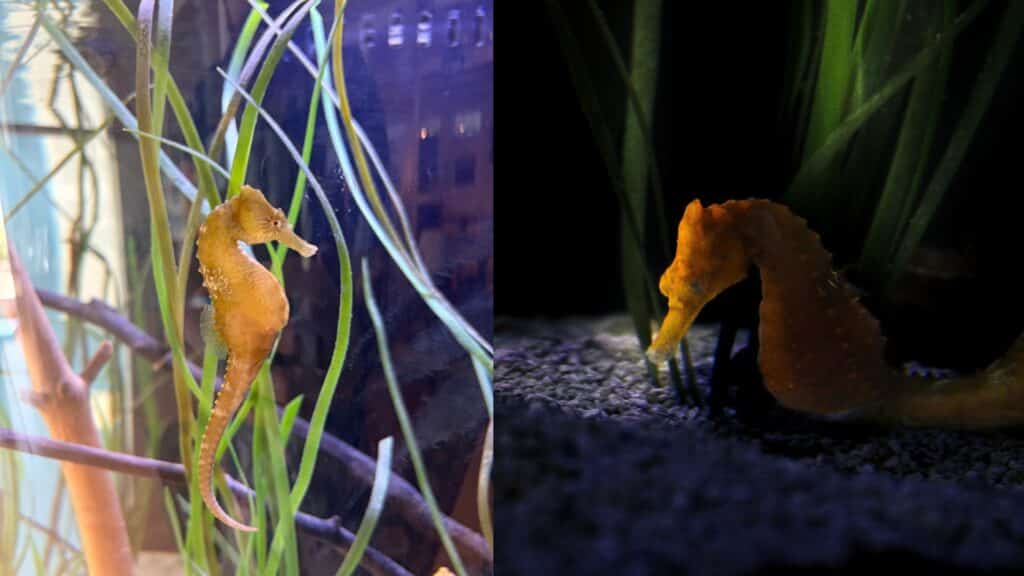
When people think about marine life in the Gulf of Maine, whales, seals, lobsters, and puffins usually come to mind. Few realize that one of the ocean’s most fascinating animals quietly calls these waters home: the lined seahorse.
Now, visitors to the Shaw Institute’s Environmental Education Center, in downtown Blue Hill, can meet these remarkable fish up close in our newest living exhibit.
While they may look like creatures from a fantasy novel, lined seahorses (Hippocampus erectus) are very real—and they represent one of the most unique adaptations found anywhere in the marine world.
A Fish Unlike Any Other
At first glance, it’s hard to believe seahorses are actually fish.
Unlike most fish, they swim upright instead of horizontally. Their bodies are covered in bony plates rather than scales, giving them a natural suit of armor. Instead of powerful tails used for swimming, seahorses have prehensile tails that act like tiny hands, allowing them to wrap securely around eelgrass, seaweed, and other underwater plants to avoid being swept away by currents.
Their horse-like head gives them their name, but it’s only one of many unusual characteristics.
Even their eyes work independently, allowing them to watch for predators in one direction while searching for food in another.
“Lined seahorses are unlike almost any other fish you’ll encounter,” said Mikey Vittum, Lead Aquarist at the Shaw Institute. “Everything about them—from the way they swim to the way they reproduce—demonstrates how remarkably diverse marine life can be. They’re a wonderful reminder that some of nature’s most extraordinary species are found right off our own coastline.”
Tiny Hunters
Despite their peaceful appearance, lined seahorses are skilled ambush predators.
Rather than chasing prey, they rely on patience and camouflage. Remaining nearly motionless among the vegetation, they wait for small shrimp, copepods, and other tiny crustaceans to drift within range before sucking them into their long snouts with incredible speed.
Because they have no stomach, food passes quickly through their digestive system. That means they must eat almost constantly throughout the day to survive.
Masters of Camouflage
One of the lined seahorse’s greatest survival tools is its ability to blend into its surroundings.
Their color can vary dramatically depending on their environment, ranging from tan and brown to yellow, orange, gray, or nearly black. Some even develop small skin filaments that resemble algae or seagrass, making them even more difficult for predators to spot.
This natural camouflage helps them disappear into eelgrass meadows, one of the Gulf of Maine’s most important coastal habitats.
The Fathers Who Give Birth
Perhaps the most famous fact about seahorses is also the most extraordinary:
The males become pregnant.
After an elaborate courtship dance, the female transfers her eggs into a specialized brood pouch on the male’s abdomen. The male fertilizes the eggs and carries them for several weeks while they develop.
When it’s time, he experiences muscular contractions that can last for hours as he gives birth to dozens—or even hundreds—of fully formed baby seahorses.
It’s one of nature’s rare examples of male pregnancy and one of the reasons seahorses continue to fascinate scientists around the world.
Life in the Gulf of Maine
The Gulf of Maine marks the northern edge of their natural range, making sightings relatively uncommon. Here, they depend heavily on eelgrass meadows, underwater flowering plants that provide shelter, food, and nursery habitat for countless marine species.
“People are always amazed when they learn these incredible animals actually live in the Gulf of Maine,” said Vittum. “Seahorses have some of the most unique adaptations in the ocean, from the males carrying the babies to using their tails to anchor themselves in eelgrass. They’re the perfect species to help visitors appreciate just how extraordinary our local marine ecosystems really are.”
Unfortunately, eelgrass has been declining throughout the Gulf of Maine due to warming waters, coastal development, declining water quality, and disease.
Because healthy eelgrass supports everything from juvenile fish and shellfish to seahorses, protecting these habitats benefits an entire coastal ecosystem.
Vittum noted: “Our seahorse exhibit provides an opportunity to tell the story of eelgrass meadows and why protecting these habitats matters. When people connect with an animal like a seahorse, they begin to understand that every part of the ecosystem plays an important role.”
Why Our Exhibit Uses Synthetic Eelgrass
Visitors may notice that our aquarium features realistic synthetic eelgrass instead of live plants.
That’s intentional.
Real eelgrass is increasingly difficult to obtain because of its ecological importance and ongoing conservation efforts. Using high-quality artificial eelgrass allows us to recreate this remarkable habitat while helping protect the natural meadows found along Maine’s coast.
The exhibit offers a realistic window into one of the Gulf of Maine’s most valuable ecosystems while reinforcing the importance of preserving the real thing.
Meet Them in Person
Watching lined seahorses gently sway with the current is unlike observing almost any other marine animal. Their graceful movements, curious behavior, and remarkable biology make them one of the highlights of the Shaw Institute’s Environmental Education Center.
Whether you’re visiting with young children, exploring Maine’s coastal wildlife, or simply curious about the incredible diversity hidden beneath the ocean’s surface, our lined seahorse exhibit offers an unforgettable opportunity to discover one of the Gulf of Maine’s most captivating residents.
Stop by the Environmental Education Center and experience these amazing animals for yourself—you may never look at the ocean the same way again. Summer hours are Wednesday to Saturday, 10am to 4pm.
Did You Know?
🐴 Seahorses are fish.
Even though they don’t look like typical fish, seahorses breathe through gills, have fins, and spend their entire lives underwater.
👀 Their eyes move independently.
A lined seahorse can look forward with one eye and behind itself with the other, helping it watch for predators while searching for food.
🤰 Male seahorses give birth.
After the female deposits her eggs into the male’s brood pouch, he fertilizes them, carries the developing young, and eventually gives birth to dozens—or even hundreds—of tiny seahorses.
🍤 They eat almost constantly.
Because seahorses don’t have a stomach, food passes through their bodies very quickly. They need to feed throughout the day on tiny shrimp, plankton, and other small crustaceans.
🌿 Their tails can grab onto plants.
Unlike most fish, seahorses have a prehensile tail that wraps around eelgrass and seaweed, helping them stay anchored in moving water.
🎭 They are camouflage experts.
Lined seahorses can change shades to better blend into their surroundings, making them much harder for predators—and even people—to spot.
❤️ Many seahorses form long-term pairs.
While not every pair stays together for life, lined seahorses often remain with the same mate throughout a breeding season and greet each other each day with an elaborate courtship dance.
📍 Maine is the northern edge of their range.
The Gulf of Maine is one of the northernmost places in the world where lined seahorses naturally occur, making them a particularly special species to showcase at the Shaw Institute.