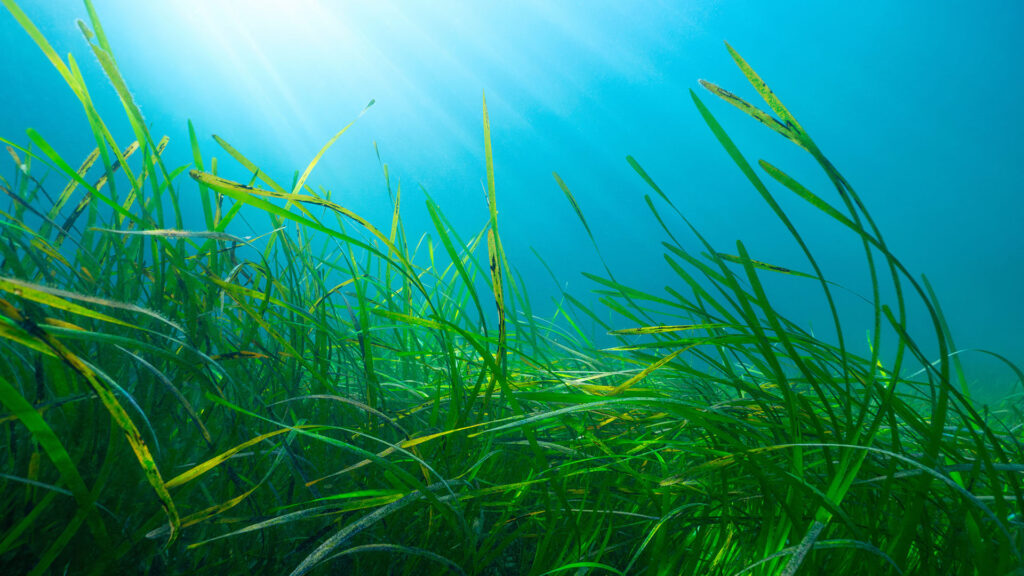
Did you know that there’s a plant that can bloom in the ocean? The common eelgrass (zostera marina) is a plant that can create entire meadows underwater, serving as safe havens for countless ocean critters. Dive in and discover why this remarkable plant is so essential to Maine’s waters, the growing threats it faces, and how local efforts (including our team at the Shaw Institute!) are working to protect it before it’s too late.
Ecology
Common eelgrass is one of the few true plant species that grow in marine environments. Found in shallow waters up to 35 feet deep, this grass even produces flowers that bloom underwater! Unlike algae that have “holdfasts” to attach to surfaces, eelgrass is considered a true plant because it has roots to extract nutrients from the substrate around it.
Why is it so Important?
Eelgrass meadows act as nurseries for countless species of fish and invertebrates. They help create oxygen in areas of slow water flow, providing shelter and nutrients for young animals while preventing erosion with their deep-reaching roots. This not only protects crucial habitats, but also helps cushion coastal communities during storm surges and floods.
Threats
Unfortunately, Maine has recently lost over 65% of its eelgrass meadows due to a variety of factors. Long stints of unusually hot weather cause water temperatures to rise to the point that it cooks and kills the eelgrass. Invasive species like the infamous European green crab (Carcinus maenas) also contribute to the decline by eating seeds and uprooting young grass. Human activity, pollution blocking sunlight, and eelgrass wasting disease are other key causes for the sharp decline in meadow coverage.
Helpful Efforts
There are several organizations throughout coastal Maine working tirelessly to protect remaining eelgrass and reseed damaged populations. The Shaw Institute is doing its part by showcasing lined seahorses, a native species to the Gulf of Maine, and educating folks on how they rely on eelgrass meadows. If something isn’t done to restore these habitats, we risk losing seahorses from our shores entirely.
Get Involved
Are you looking for a way to contribute to your local community? If you’re near Blue Hill, Maine, you can help keep our coastal waters clean and healthy by joining us for our community beach cleanups!
Want to see why a thriving coastal ecosystem matters so much? Stop by our Environmental Education Center to see our live seahorses in their new aquarium equipped with a synthetic representation of eelgrass stressing the important role the living plant plays in a fragile ecosystem!
Learn more about our research, events, and community outreach at shawinstitute.org.
Did You Know?
There’s a grass that can bloom fully underwater.
Unlike seaweed or algae, common eelgrass (Zostera marina) is a true marine plant with root systems that absorb nutrients from the sediment—and it even produces flowers that bloom up to 35 feet beneath the surface!
Eelgrass acts as a natural shield for coastal towns.
Eelgrass meadows form deep root systems that lock substrate in place to prevent erosion, while their dense blades help cushion shorelines against storm surges and flooding.
Marine meadows serve as underwater nurseries.
These underwater grass beds generate oxygen in slow-moving waters and provide crucial food and shelter for young fish, invertebrates, and native species like lined seahorses.
Maine has lost more than 65% of its eelgrass meadows.
Rising water temperatures from extreme heat events are quite literally cooking the grass, while invasive European green crabs uproot young plants and eat seeds, devastating local populations.
There’s a synthetic eelgrass habitat in Blue Hill that you can visit.
The Shaw Institute’s Environmental Education Center features a live lined seahorse aquarium with a replica eelgrass setup to highlight how deeply these gentle creatures depend on healthy meadows to survive.