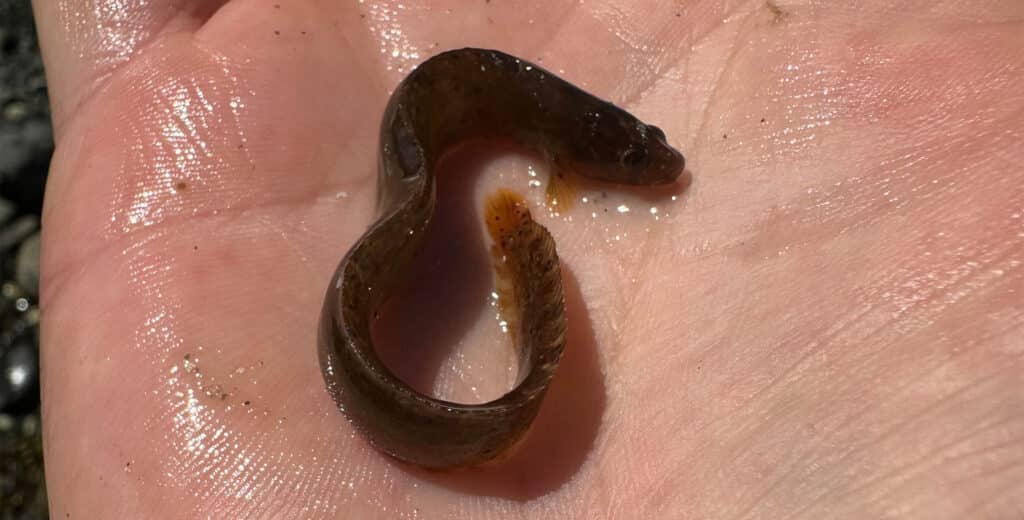
They look like eels, breathe air at low tide, and dress up in autumn orange—come meet our favorite local fish in Blue Hill.
Many species of fish change colors around their breeding seasons, including rock gunnels commonly found in the coastal waters of the North Atlantic Ocean. There are times when their dorsal and pectoral fins will turn a bright orange, just like the leaves of our favorite Maine trees during the fall!
Stop by Shaw Institute’s Education Room in the Environmental Education Center to say hello to Shaw’s very own rock gunnels in the Rocky Intertidal Tank. And if you look closely, you’ll notice some of them are showing off bright orange fins!
It’s a fish, not an eel
While rock gunnels may look like an eel due to their long, slim bodies, they’re actually a type of fish! An easy way to tell them apart is to look at their fins and coloring.
Rock gunnels have large, distinct pectoral fins; those are the fins on each side of their body close to their face. They use these fins to help maneuver around and between rocks. Eels also have pectoral fins, but they are much smaller and less pronounced.
Rock gunnels have a brown coloring with dark-eyes-spot-patterns down the top of their body, while eels are a solid dark brown on the top half of their body and a pale white on the underside.
The doting parent
Unlike most fish, rock gunnels care for their eggs for 8-10 weeks while they wait for them to hatch.
A female rock gunnel can lay up to 200 eggs at a time. These eggs are super sticky and will form into a tight ball that both the male and female will take turns guarding fiercely against hungry crustaceans and fish.
Once the eggs hatch, the new members of the family go out on their own into deeper waters as tiny, pelagic larvae. They’ll stay there for a couple of months before settling back into an intertidal zone sheltering in the crevices of rocks and among the algae and seaweed.
Life above the waterline
Rock gunnels are able to live out of the water for up to twenty hours by hiding in and around damp seaweed and rocks!
As tides recede, these resilient creatures may be stranded in shallow rocky pools or exposed entirely above the waterline until the next high tide sweeps back in! In order to survive this, this marine species produces a special thick slime-coating that allows them to keep their gills wet for extended periods of time.
They can also “gulp” a big breath of air and absorb it through their skin and throat instead of through their gills!
The reason behind their color change
Male rock gunnels will turn the top of their dorsal fin and their pectoral fins bright orange during breeding season. This is due to a rise in hormones, called ketotestosterone, and it signals to the ladies that he’s big, strong, healthy, and ready to be a dad.
In many types of fish, a temporary change in color during breeding seasons signals that they are healthy. If an animal is able to put precious energy and resources into making themselves a different color, (an act that is not needed for survival), that signals that they are probably doing pretty well for themselves.
They change with the season
Their breeding season generally starts in mid-November and ends as late as April, but they don’t know or care about the month.
Rock gunnels use seasonal cues to know when to change color. Those cues are usually the change in water temperature and the amount of light they experience during that part of the year. Basically, once the water gets colder and the days get shorter, they start to change into their fall colors!
Catch up with our Critters
You can visit rock gunnels and all our other critters at Shaw Institute’s Environmental Education Center at 55 Main St in Blue Hill, ME. Admission is currently free, but donations are welcome to keep our doors open and animals happy.
Support Our Educational Efforts
Hosting marine life for educational impact and awareness are made possible through the generosity of donors and supporters. Contributions to the Shaw Institute allow us to continue having a robust and attractive aquarium experience for our marine life and youth engagement. It allows the institute to host exciting events, conduct vital environmental research, and empower local youth to meet modern challenges with fresh perspectives. To support our mission and help inspire the next generation of conservationists, please consider making a donation to the Shaw Institute today.