How groundbreaking microplastics research, local coastal monitoring, and hands-on STEAM education can bring community investment full circle.
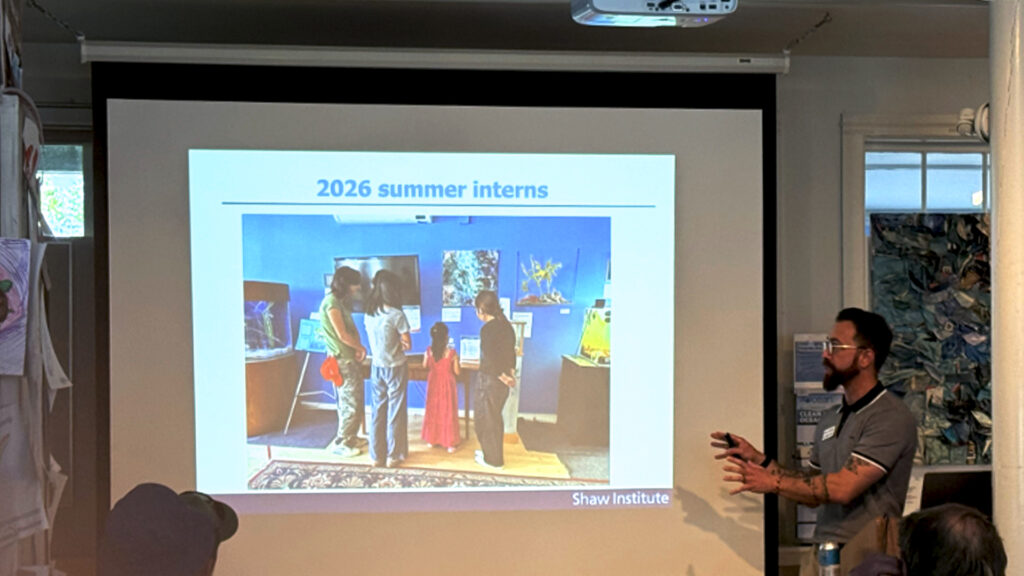
On August 18, neighbors, donors, and marine research enthusiasts filled Shaw Institute’s Blue Hill Research Center for its public community updates event, a night built around a simple goal: getting its local community back through the doors. Guests were able to meet new aquarium residents and hear updates from Executive Director Dr. Charlie Rolsky about our impactful year of microplastics and PFAS research tied to major universities, our coastal water monitoring efforts across Blue Hill Bay, and an evolving partnership with George Stevens Academy (GSA) that will expand student access to science, technology, engineering, and math (STEM) pathways and career skillsets.
National Impact
An impactful topic that was highlighted at the event was the purchasing of a key research instrument in 2024, the pyrolysis GC/MS, which has allowed Shaw Institute to analyze human tissue for three university partners that has included the review of 87 placenta samples for NYU Langone Health, tied to fetal growth and chronic disease; 33 brain and spinal fluid samples for Arizona State University’s Biodesign Institute, tied to Alzheimer’s and Parkinson’s; and 60 colon samples for a Harvard Medical School pilot study on inflammatory bowel disease. The instrument has allowed us to increase opportunities around collaborations and contribute to research in human health studies related to microplastics on a national scale. New grants through the Arizona Alzheimer’s Consortium, National Institutes of Health (NIH), and Arizona State University’s Horizon Europe program are expected to bring hundreds more sample-testing opportunities to our institute over the next few years, and a Rolsky-coauthored paper on marine mammals and plastic pollution was recently published in Conservation Biology this spring.
Driven by that same push for scientific accuracy and transparency led Dr. Rolsky to the SETAC Europe conference in Maastricht in May, where he and fellow researcher Dr. James Brown co-chaired a session titled “Microplastics Research: Beyond Fear-Mongering, Towards Trustworthy Science.” Demand to attend the presentation session outgrew the room so fast that organizers moved the talk into a 1,000-person hall mid-conference, making it the best-attended session of the entire meeting. During the talk, researchers there dug into characterization errors, analytical bias, and the ethics of communicating uncertain findings honestly; values that the Shaw Institute holds itself to across all facets of operation.
Local Impact
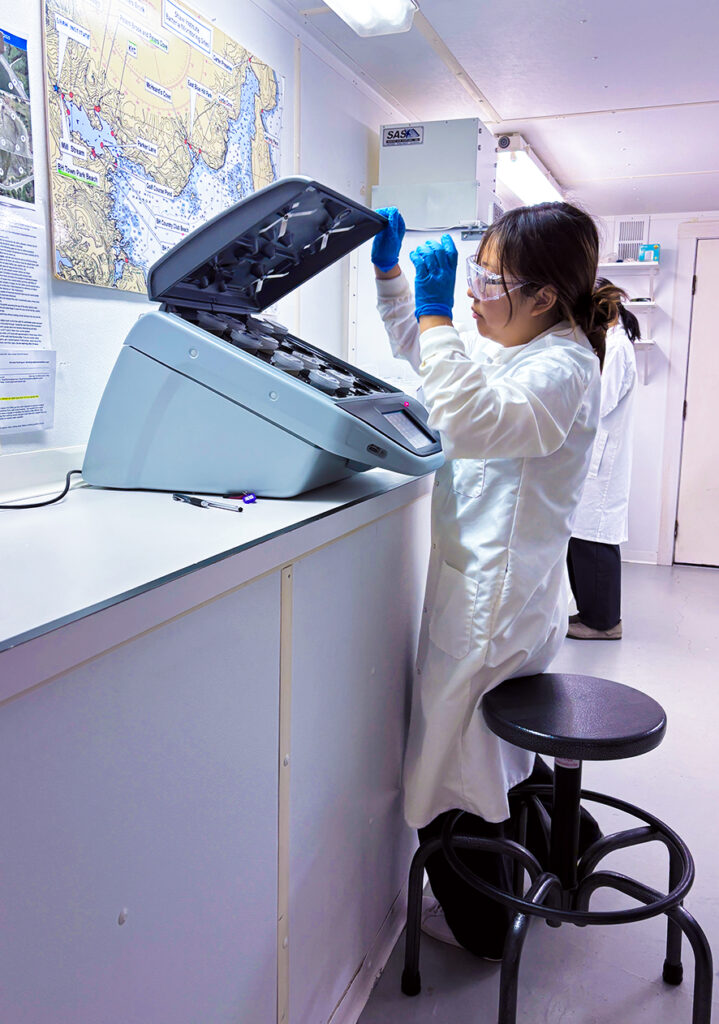
This year, Shaw Institute’s summer interns ran more than 200 bacteria tests related to our coastal monitoring efforts, and counted 2,500+ phytoplankton samples across Blue Hill Bay. In partnership with Allied Whale and the College of the Atlantic, the institute is continuing a 30-year, NOAA-funded study analyzing PFAS levels in seal tissue to determine how long these chemicals persist and whether they cause long-term harm. It has also been a summer of humpback whale sightings as they have been feeding close to shore in Stand Cove and across Blue Hill Bay! A sign of rebounding pogie stocks and a good reminder that boaters should give whales a wide, engine-neutral berth when out on the waters to avoid any collisions or accidents.
The three students in our summer intern cohort represented three different campuses including Bowdoin, Colby, and Oberlin College. They worked with 10 different organizations on tissue, water, and plastics testing. GSA senior Oliver Boit has spent two years analyzing human tissue for microplastics in the lab and was just accepted into a competitive forensic science program at Virginia Commonwealth University. This fall, the Shaw Institute and GSA will launch a semester-long honors course titled Scientific Research Experience. Dr. Rolsky developed the curriculum and will teach the class on a volunteer basis, generously minimizing costs so the school only needs to fund a teaching assistant.
Rooted in Community While Reimagining the Future
In previous years, a shift toward national-scale research meant setting aside our local outreach, including closing our original touch tank, which was a loss felt deeply across the community. Under new leadership, we’ve refocused our core mission on supporting our local community and using that strong foundation to make an impact on a national level.
Today, our ever-evolving Environmental Education Center features a brand-new 200-gallon touch tank alongside engaging education and outreach programming built to inspire the next generation of STEM professionals. Both are open year-round, expanding far beyond special events. We have welcomed record crowds this year, including homeschool groups, class tours, Girl Scout troops, and 365 visitors during the Blue Hill Maritime Festival. Sustaining and expanding these youth experiences relies directly on local community investment working hand-in-hand with our grant funding.
While the original plan and budget for prioritizing local engagement simply funded reopening the touch tank and conducting environmental research, the public’s overwhelming enthusiasm and demand for year-round programming inspired the institute to continually stretch its scope to keep pace with the community’s incredible support.
If you supported Shaw Institute in the past, we warmly invite you to take another look at how we’ve grown. The incredible demand for our programs has outpaced our original predictions, and your support ensures we can fully resource these well-loved community initiatives for years to come. Contributions made at shawinstitute.org/donate directly sustain our research, keep educational programming free for all, and protect Maine’s coastal waters for swimming and harvesting, benefiting our local community that in turn can benefit national measures.