A new course proves high schoolers aren’t just simulating science—they are providing critical data to protect Downeast Maine’s ecosystems.
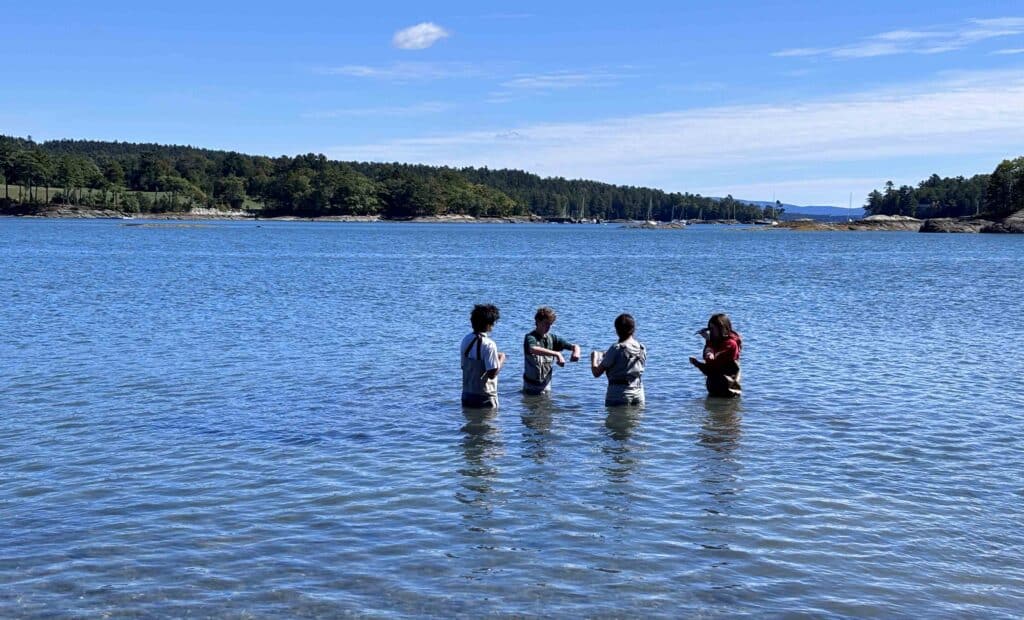
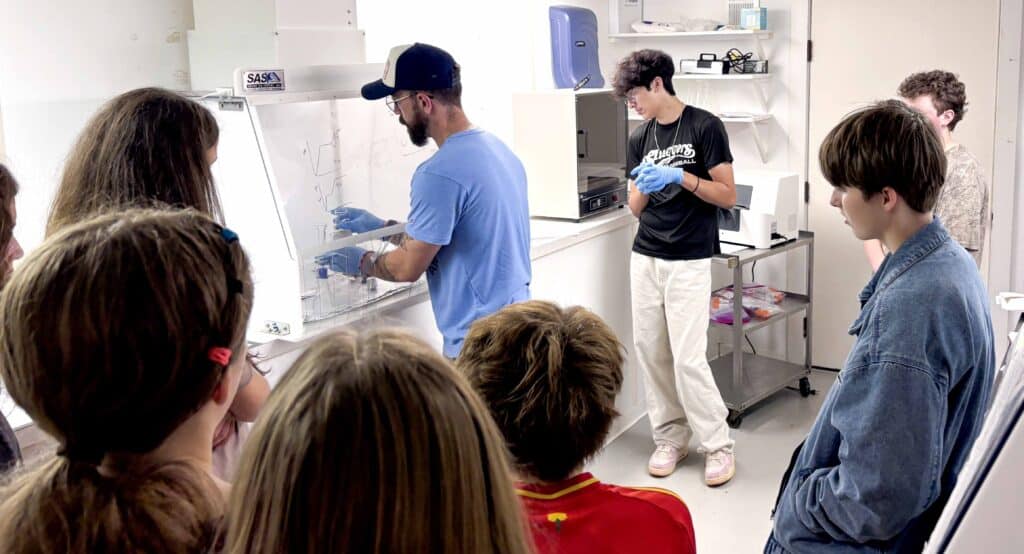
This fall, a group of George Stevens Academy (GSA) students have traded their textbooks for lab coats and waders. Through a new course called Scientific Research Experience Honors, they are spending the semester at the Shaw Institute. These students will be working in our labs and along the coastline they grew up on, conducting hands-on research that will benefit their communities, and provide real-world skills for their future careers.
The environmental questions facing the Blue Hill Peninsula, from microplastics to water quality, will need adept people to answer them. We think some of those people are already here, sitting in a high school classroom a few miles from our door. This is why the partnership between Shaw Institute and GSA is seen as an investment in the next generation of coastal stewards and STEM workforce professionals.
To help bring this unique opportunity to students, Shaw Institute Executive Director Dr. Charlie Rolsky is volunteering his time to write and teach the Scientific Research Experience Honors course all semester. While GSA is providing support for a teaching assistant, Dr. Rolsky is donating the curriculum, instruction, and his mentoring hours in the lab, and field, to ensure students have access to real-world science.
For Charlie, the reason is personal. “I grew up in rural Montana, where opportunity was often measured by how far you were from a mentor or a lab,” he says. “Maine can feel the same way.”
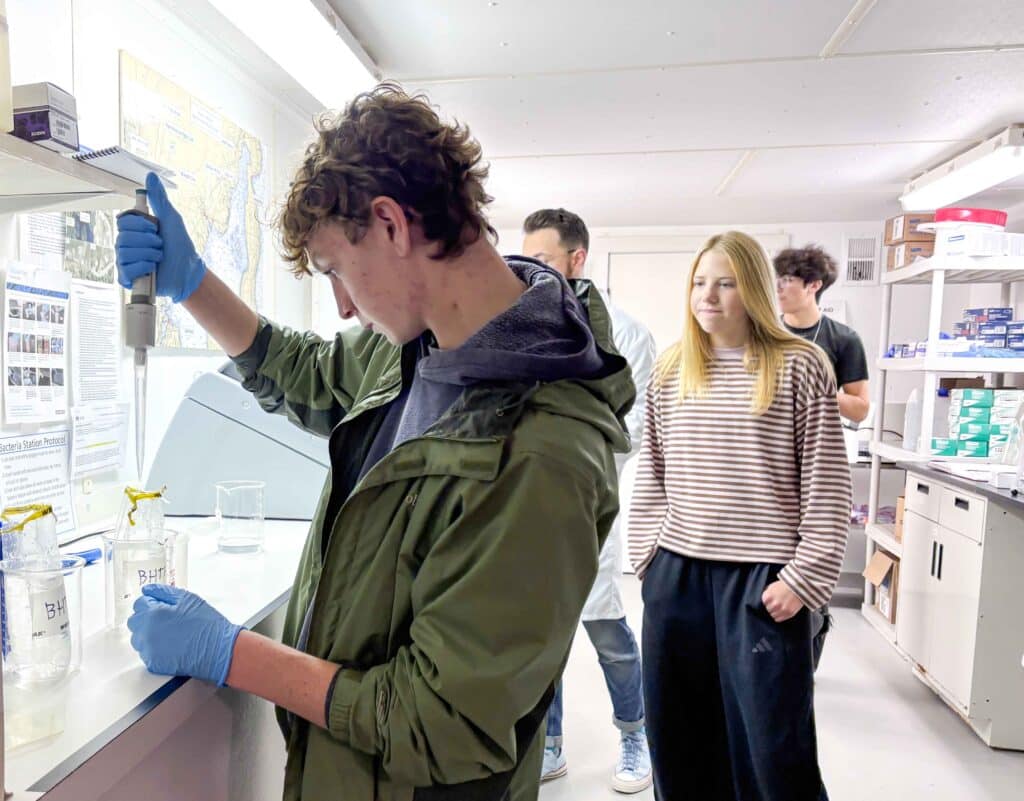
This class shortens that distance. Students are not reading about how science gets done—they are handling live data, running lab analyses, and collecting samples in the field alongside a working scientist, on questions that do not yet have answers.
Real-world science and research
The work students do in this course is not a simulation. They are contributing to the same projects our scientists are running this year:
- Testing water quality: Testing local waters for bacteria that can contribute to better understanding public health.
- Harmful algae in our bay: Checking water samples for species like Alexandrium, the phytoplankton behind red tide.
- Microplastics and human health: Supporting our microplastics research, including the analysis of human tissue samples.
As part of the curriculum, students conducted routine bacteria analysis at the local town park. They extended our coastal water testing past the traditional Labor Day cutoff. This led to the capture of unprecedented data that Shaw Institute and Blue Hill would not otherwise have had. The student’s samples, collected immediately following a recent fall nor’easter, revealed record-breaking pollutant levels. Post-storm monitoring is critical to public health, as heavy rain and storm surges frequently wash land-based contaminants and sewer overflows straight into the bay.
A typical water quality test reading falls between 20 and 104 on a scale of bacteria presence. The higher the numbers, the lower the water quality is. When our tests come back with a number of 104 or above, Shaw Institute will issue a health advisory to the community so they are aware of the water situation and can take necessary precautions. Our students’ post-storm-tested samples ended up coming back with the number 4,000—the highest level we have ever recorded!
By connecting classroom research to real-world outcomes, student work expands Shaw Institute’s mission to safeguard local ecosystems. A single sampling trip showed us something new about how storms affect this coastline, and it was high school students who discovered this.
Our local community has already seen how access to STEM opportunities and research experience can lead to unexpected career trajectories. GSA senior Oliver Boit spent a year in our lab analyzing human tissue samples for micro- and nanoplastics, the same kind of samples sent to us by researchers at Harvard, NYU, and Arizona State for analysis. He went on to earn a place in a competitive forensic science program at Virginia Commonwealth University, an opportunity he credits Shaw for allowing him to recognize and pursue.
Mentorship at Shaw Institute
Students shadow Charlie directly, in the lab and in the field, and see how a working scientist makes decisions as the data comes in. For the seniors in the class, that mentorship extends past the coursework. As they weigh colleges and careers, they have a scientist to talk through their options with, and real research experience to add to their credentials when they apply.
This course allows an entire class to learn lab techniques and field methods, as well as understand the nuance in how a research question is framed, how data is checked, and how scientists talk about results. These skills are carried into college applications, internships, and careers in science, health, engineering, and environmental work. Here at Shaw, we feel it is incredibly important that students get to see that a career in science is possible without leaving home to find it.
For more than 30 years, the Shaw Institute has studied environmental health. Teaching local students is a natural extension of that history. The people who will carry this work forward are the ones who will call this place home, and we are working to empower the next generation to do this work.
An investment in our community and the future
Charlie’s time is donated, but the class still has real costs. Research grants pay for specific projects. They do not pay for the lab supplies a semester-long class uses, the equipment students train on, or the field gear that gets them out on the water.
That is where community support comes in. A gift to Shaw Institute is a direct investment in the Blue Hill Peninsula and in the young people growing up here. It pays for the equipment, lab access, and field resources these students rely on, and it builds a sustainable model for community-driven science that does not depend on any one person.
If you believe world-class science can happen in our own backyard, help us keep it here. Donate today at shawinstitute.org/donate, or visit Shaw Institute and see the work we are doing in conservation, health, and youth STEM engagement, for yourself.